Archived board. This is a read-only archive of the Fast Tracks forums, active 2004–2016. Posting closed in May 2016; the board was preserved as a static site in 2026. Some images were lost before archiving and are marked where they appeared.

Fast Tracks

Model Railroading Discussion Forums

Return To The Fast Tracks Website

The Fast Tracks discussion forums have been closed. Click Here for more information.

It is currently Thu Aug 06, 2026 12:00 am

All times are UTC - 5 hours [ DST ]


Forum locked This topic is locked, you cannot edit posts or make further replies.  [ 8 posts ] 
Author Message
PostPosted: Sun May 07, 2006 1:55 pm 
Offline

Joined: Sun May 07, 2006 1:39 pm
Posts: 3
Location: UK
I'm sure these are questions that you've heard many times but I hope you be kind enough to help me.
I'm just putting together a shopping list to purchase everything to start laying track for my HOn3 layout.

About how many ties would be needed per foot of track in HOn3?

What code rail would you recommend for a HOn3 layout?

I've been unable to find out what the prototype used so this decision would be based on the type of traffic on the prototype.
I'm modelling the Oahu Railway & Land Co circa 1942. Heavy freight traffic in the pre-war year suggests heavy duty rail and the company ran four 2-8-2 Mikados (similar to the K28) which might point to Code 70.
My own guess would be Code 70 but I think Code 55 might give a more scale appearance. I'd be grateful for any thought on the matter.


Top
 Profile  
 
 Post subject: HOn3 Track
PostPosted: Mon May 08, 2006 7:08 pm 
Offline
User avatar

Joined: Sat Aug 13, 2005 10:48 am
Posts: 365
Location: East Texas - USA
Plan on 36 to 38 ties per foot of narrowgage track. This works out at about 28" center spacing - fairly normal for narrow gage track. Better maintained and heavy duty track may get closer to 40 ties per foot.

I would recommend using the code 55 for HOn3 - except perhaps on main lines only you could use code 70. Any dual gage effort would be best with code 70, but the code 55 will appear much better. It's not the height so much as the head and base widths that creates the illusion of 'finer' appearance.

_________________
-ed mccamey-
COSLAR RR - http://www.coslar.us/
NMRA Standards and Conformance Department
PROTO & FINE Scale Coordinator
I estimate I have about 5 pounds of coupler springs somewhere in the vicinity of my workbench.


Top
 Profile  
 
 Post subject:
PostPosted: Mon May 08, 2006 7:37 pm 
Offline

Joined: Mon May 24, 2004 6:02 pm
Posts: 63
Location: vestal, ny
i second emccamey suggestion.
c55 rail in HO eqates to 'bout 75lb rail...good for most narrow gauge rr's and older operations.
c70 rail in HO eqates to 'bout 100lb rail...better for mainline and larger/newer operations.


Top
 Profile  
 
 Post subject:
PostPosted: Tue May 09, 2006 8:46 am 
Offline

Joined: Sun May 07, 2006 1:39 pm
Posts: 3
Location: UK
Thanks for the response, Chaps. Just what I needed!
No excuse now for not getting started.


Top
 Profile  
 
 Post subject:
PostPosted: Wed Jun 14, 2006 8:24 am 
Offline

Joined: Sun May 07, 2006 1:39 pm
Posts: 3
Location: UK
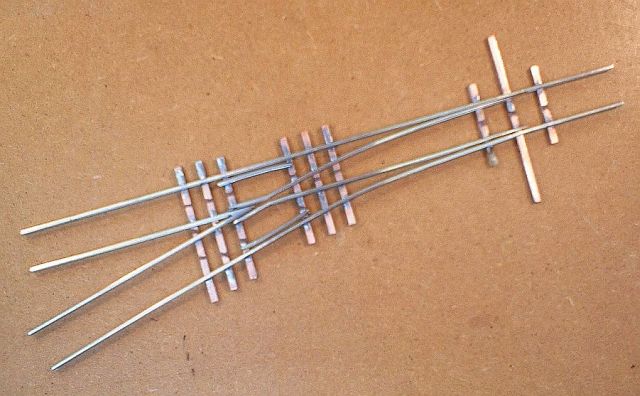
Here's my first attempt with the Fast Tracks assemble fitting. A HOn3 Number 4 turnout, that worked first try!!
Poor quality pic, sorry!


Attachments:
TO01.jpg
TO01.jpg [ 59.59 KiB | Viewed 14121 times ]
Top
 Profile  
 
 Post subject: HOn3 Turnout
PostPosted: Wed Jun 14, 2006 8:44 am 
Offline
User avatar

Joined: Sat Aug 13, 2005 10:48 am
Posts: 365
Location: East Texas - USA
Les,

Nice work on 1st try! Be sure to cut the gaps at the frog once installed well and use contact points to wire the frog - you'll have great electrical reliability as well.

_________________
-ed mccamey-
COSLAR RR - http://www.coslar.us/
NMRA Standards and Conformance Department
PROTO & FINE Scale Coordinator
I estimate I have about 5 pounds of coupler springs somewhere in the vicinity of my workbench.


Top
 Profile  
 
 Post subject: Track info.
PostPosted: Tue Aug 08, 2006 4:07 am 
Aloha Les- A fellow model railroader led me to this site, and after what l read, l just had to register! Good to see that the Oahu Railway has interests across the pond! Being that you're hand laying the track, the practice here on Oahu, was to utilize standard gauge ties. The reason being is that since a lot of the mainline was situated near the ocean, should the ties rot where the spikes are, the track gang could just pull out the spikes, slide the tie left or right, then respike them. There are several photos featuring uneven tie placement on several parts of the line. As for ballast, coral was extensively used throughout the entire railway. Even to this day, one can easily locate the existing ROW just by the long trail of crushed coral. For my layout, l'm using the crushed coral, but griding it down further to a granular consistency. l thought of using the white beach sand which l have access to right down the road, but so far the coral looks prototypical, although there's quite a bit of work to get it just right. Hope this will help you.


Top
  
 
 Post subject:
PostPosted: Tue Aug 08, 2006 2:15 pm 
Offline

Joined: Mon Jul 10, 2006 12:59 pm
Posts: 1
Dear Les,
About OR&L track spacing: Moku156s' comments are confirmed by field observations.

I live near a stretch of track in Nanakuli (abandoned since 1968, but still in place) which originally was part of the OR&L main line, and finally used by the U.S. Navy to connect the Lualualei ammunition depot with the loading area on the West Loch of Pearl Harbor. As you might imagine, the ties are pretty rotted out, and the rails are coming off the ties in places. (there is a restored "live" stretch of track about 2 miles southeast on which the Hawaiian Railway Society runs weekend excursions)

I measured a 25-foot section of track (all dimensions are approximate because of the bad condition of the ties and rails, which are partially buried in sand):
The 25 foot tape measure would touch the inside face of the first tie and extend about 2 inches into the 13th tie.
Doing the math, this works out to:
24'-10" (298 inches)-(11 ties*8 inches/tie width)=(12 inter-tie spaces* width of 1 space)
or about 17.5 inches space between ties (round off to 18 inches)

All ties were originally 6x8 inches in cross section. 11 out of the 13 were 8 feet long (standard gauge length), offset as Mokus156 mentioned. Two were 6 feet long but I dont know if they were originally 8 feet and trimmed later by the US Navy section gangs. (I dont know if the US Navy continued OR&L's track maintenance practices. Perhaps Mokus156 has better info on this subject.)

I must admit that I am real curious about your HOn3 layout. As far as I know you are the only one that is actually building an Oahu Railway layout in HOn3. Hope you don't mind the "niele" (nosey) questions.

What part of the OR&L are you modeling?
What are you using for locomotives and rolling stock?
Any plantation or military rail interconnections?
what are you using for buildings/structures?
How far advanced is your layout construction?
What are you using as data references for your layout 10,000 miles and 64 years away from the prototype?
I would really like to see your track plan and any photos, etc of what you are bulding, especially since WWII was definitely OR&L's "finest hour".

I did build a few HOn3 OR&L box and flat cars a few years back, and converted an old Westside HOn3 K-28 into OR&L # 70 about the same time (a very frustrating task without a resistance soldering unit!).

Take care,
Bertschi


Top
 Profile  
 
Display posts from previous:  Sort by  
Forum locked This topic is locked, you cannot edit posts or make further replies.  [ 8 posts ] 

All times are UTC - 5 hours [ DST ]


Who is online

Users browsing this forum: No registered users and 1 guest


You cannot post new topics in this forum
You cannot reply to topics in this forum
You cannot edit your posts in this forum
You cannot delete your posts in this forum
You cannot post attachments in this forum

Search for:
cron
Powered by phpBB® Forum Software © phpBB Group