Archived board. This is a read-only archive of the Fast Tracks forums, active 2004–2016. Posting closed in May 2016; the board was preserved as a static site in 2026. Some images were lost before archiving and are marked where they appeared.

Fast Tracks

Model Railroading Discussion Forums

Return To The Fast Tracks Website

The Fast Tracks discussion forums have been closed. Click Here for more information.

It is currently Thu Aug 06, 2026 12:00 am

All times are UTC - 5 hours [ DST ]


Forum locked This topic is locked, you cannot edit posts or make further replies.  [ 16 posts ]  Go to page 1, 2  Next
Author Message
 Post subject: soldering
PostPosted: Sat Jun 09, 2007 12:41 pm 
Offline

Joined: Sat Jun 09, 2007 12:37 pm
Posts: 2
Location: Houston
Help-I have watched the video on soldering. Everytime I try to solder feeder to frogs, they come unsoldered. Not sure what I am doing wrong.

At what point do you actually solder the feeds to the turnout?
I have tried one without ties and one with. both difficult due to heat undoing other solders.
Please give advice. thanks
ps--was trying to do soldering to bottom of rail before installing on roadbed. should I wait until installing and/or solder to side of rail?


Top
 Profile  
 
 Post subject:
PostPosted: Mon Jun 11, 2007 12:58 pm 
Offline
Site Admin

Joined: Fri May 07, 2004 11:22 pm
Posts: 311
Location: Port Dover, Ontario
Hi,

The trick to getting a feeder soldered to the completed frog is speed. I believe you are soldering to the bottom of the frog (with the turnout turned over) and if the heat is left too long the frog can come unsoldered. Try doing this step with the turnout resting on the fixture (not in the fixture), this will act as a bit of a heat sink and give a bit more time to solder the feeder in place.

If you are still finding this step difficult it is possible to solder the feeder to the PC board tie beside the frog. Bend the exposed piece of wire to a short 90 "hook" and solder it to the top of the PC board tie. When painted and ballasted in place the wire will be almost inviable.

_________________
Cheers!

Tim Warris
Fast Tracks
http://www.fast-tracks.net
service@fast-tracks.net


Top
 Profile  
 
 Post subject: frog soldering
PostPosted: Mon Jun 11, 2007 3:28 pm 
Offline

Joined: Sat Jun 09, 2007 12:37 pm
Posts: 2
Location: Houston
Thank you for the suggestion. I think I will try soldering to the tie. Never made my own turnouts before, so this is all new.


Top
 Profile  
 
 Post subject: Attaching leads
PostPosted: Tue Jun 19, 2007 3:47 pm 
Offline

Joined: Tue May 29, 2007 12:20 pm
Posts: 100
Location: Oklahoma City, OK
One thing I have learned to speed up the process is to make sure the end of the lead wire has been pre-tinned. I will make a lot of difference in time to attach and the heat involved.

_________________
Kurt Konrath

SP was king of the road, Cotten Belt will run forever! D&RGW will rule the hills!


Top
 Profile  
 
 Post subject:
PostPosted: Tue Dec 04, 2007 12:47 am 
Offline
User avatar

Joined: Wed Oct 11, 2006 1:14 am
Posts: 21
What about using solders with differing melting points? Hotter for constructing the frog, cooler for attaching the feeder? :?:

_________________
MikeM


Top
 Profile  
 
 Post subject:
PostPosted: Tue Dec 04, 2007 10:37 am 
Offline
User avatar

Joined: Sat Aug 13, 2005 10:48 am
Posts: 365
Location: East Texas - USA
banjobumps.

I'd not recommend different solder temps in turnout construction. Copper has a very high thermal conductivity. The copper clad on a PC tie is very thin and too high a temperature will unclad the coper bonding. It's not rally necessary, as you want to develop a technique of hot and fast soldering. Besides, the low temp solders are not good for electrical connections.

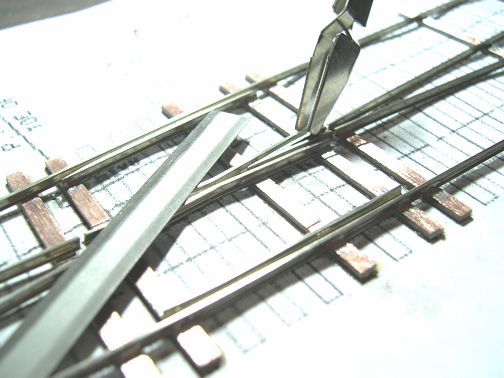
Pre-tining the PC tie and the rails and the wires make a big help in making the connection fast. If you are attaching the wires while in construction, the fixture keeps the alignments. If you are attaching after installation, the few spikes used and the solidness of the assembly keeps the alignments. I do recommend that the use of spring clamps will act as good heat sinks.

One thing to be careful of, if you are using the acid flux (I don't recommend that - use a liquid safe rosin flux), the electrical connection HAS to have a rosin flux and any acid flux left from the mechanical assembly can ruin the electrical connection latter.


Attachments:
File comment: See the spring gage - use as a heat sink.
Frog_Fit.JPG
Frog_Fit.JPG [ 44.82 KiB | Viewed 19982 times ]

_________________
-ed mccamey-
COSLAR RR - http://www.coslar.us/
NMRA Standards and Conformance Department
PROTO & FINE Scale Coordinator
I estimate I have about 5 pounds of coupler springs somewhere in the vicinity of my workbench.

Top
 Profile  
 
 Post subject:
PostPosted: Sat Dec 29, 2007 2:28 pm 
Offline

Joined: Wed Jan 03, 2007 1:18 pm
Posts: 84
Ed:

I have tried to clean up the turnouts with mineral alcohol. I use a toothbrush and essentially clean the total area by brushing the alcohol over the area with the toothbrush.

Is that enough to neutralize the acid in the flux? If not, please inform me. I do not want to make huge mistakes after my soldering is done.

I am poor at using rosin paste. I find it hard to liquidize enough so that I do not glob the stuff all over the place when trying to brush it onto the rail and tie. Also, when the tip carbonizes, how do I clean it? Do I use the towel method as shown in the video?

When soldering, more times than not, I get a blob forming at the base of the wire, with that I make a mess of the solder. Tip cleaning is likely the culprit, but is there a trick to doing the work better?

Thanks,
sambear

_________________
"Life is about learning"


Last edited by sambear on Sat Jan 03, 2009 6:36 pm, edited 1 time in total.

Top
 Profile  
 
 Post subject:
PostPosted: Sat Dec 29, 2007 3:19 pm 
Offline
User avatar

Joined: Sat Aug 13, 2005 10:48 am
Posts: 365
Location: East Texas - USA
sambear,

First - I use only the liquid rosin "Super Safe" flux, and not the acid flux that Tim recommends. http://www.ccis.com/home/hn/

It's very easy to 'paint' it on with a small brush and get to just the right places. Does very well as a flux for the mechanical soldering. And any residue would not be harmful in the long run as it's safe for electrical soldering. Comes in two consistencies - the gel is actually quite liquid and has proven to be my most used. I use this with the nickel silver rails and also with the leadalloy steel rails - solders just fine.

Alcohol will do a fair neutralization. But you will want to follow with a scrub of soapy water and then rise clean with fresh water. If I were to use the acid flux, I'd actually neutralize with a weak baking soda and water mix, then soapy water - then rise. The 'pickling' mix of saltwater and vinegar is a superior method for any flux and one of the best for painting preparation as well - again always follow with a soapy scrub and then clean rise.

Just make sure you get it CLEAN - and all else falls into place!

P.S. CLEAN means before the soldering for a good joint AND after the soldering for good residue removal.

_________________
-ed mccamey-
COSLAR RR - http://www.coslar.us/
NMRA Standards and Conformance Department
PROTO & FINE Scale Coordinator
I estimate I have about 5 pounds of coupler springs somewhere in the vicinity of my workbench.


Top
 Profile  
 
 Post subject:
PostPosted: Sat Dec 29, 2007 9:50 pm 
Offline

Joined: Wed Jan 03, 2007 1:18 pm
Posts: 84
Ed:

I followed your advice and went to the web site and bought the gel version of the 'Super Safe' flux.

You had mentioned that you used the gel version to great effect and that is was acting as a liquid, I trust that I have thus bought the correct version (gel rather than liquid) to help with my projects.

I followed up on your advice and soaked (for 30 minutes) the over twenty #6 turnouts I have built in a 50:1 mix of water to baking soda. Some of the rails turned green as did some ties, but most stayed the same colour. I then went upstairs, washed them all in dish soap, then gave each a rinse and left them to dry.

Thanks again for your advice.
-sambear

_________________
"Life is about learning"


Last edited by sambear on Fri Jan 04, 2008 1:03 pm, edited 1 time in total.

Top
 Profile  
 
 Post subject:
PostPosted: Sun Dec 30, 2007 8:46 am 
Offline
User avatar

Joined: Sat Aug 13, 2005 10:48 am
Posts: 365
Location: East Texas - USA
sambear,

You did well. The gel is really a liquid, it's only slightly thicker than the one that's marketed as liquid. It will wick under the rail base just as the acid based flux has been doing.

Green would mean that the areas had already had some chemical reactions to those components and would have eventually given problems with corrosion. The neutralization should now have worked well with your steps and the following washings removed all traces of the baking soda mix as well.

_________________
-ed mccamey-
COSLAR RR - http://www.coslar.us/
NMRA Standards and Conformance Department
PROTO & FINE Scale Coordinator
I estimate I have about 5 pounds of coupler springs somewhere in the vicinity of my workbench.


Top
 Profile  
 
 Post subject:
PostPosted: Mon Feb 04, 2008 7:20 pm 
Offline

Joined: Fri Feb 01, 2008 9:55 am
Posts: 3
Location: Brisbane Australia
Having done a military soldering course I'd just like to add a couple of suggestions.

1. I keep my tip clean by wiping it through a damp sponge after every joint.

2. Prior to turning off the iron I wipe it on a block of Sal ammoniac then add a tiny bit of solder to the tip. Sal ammoniac will keep your tip looking like new and allow the solder to flow extremely well.

Hope this helps,

_________________
Regards,

Phill
UP & SP in "N" of course!


Top
 Profile  
 
 Post subject: Re: soldering flux
PostPosted: Sat Jan 03, 2009 9:27 pm 
Offline

Joined: Wed Jan 03, 2007 1:18 pm
Posts: 84
Given that I am using SuperSafe Superior #30 Soft Solder Flux when soldering rail to ties, do I need to neutralize acid?

I have used a mix of 50:1 baking soda to wash the work (with a toothbrush), followed by a rinse of cold water. Now I wonder if this is overkill. If I just wash it in cold water, no soap, will that be enough to prevent any corrosion or shorts at a later time?

_________________
"Life is about learning"


Top
 Profile  
 
 Post subject: Re: soldering
PostPosted: Sat Jan 03, 2009 10:15 pm 
Offline
User avatar

Joined: Sat Aug 13, 2005 10:48 am
Posts: 365
Location: East Texas - USA
sambear,

Using the Supersafe flux, you will only need to wash in warm water. It doesn't hurt to use the neutralizer - but its overkill. The Supersafe is not actually an acid, but you do want to rise it off so that you can latter do your cosmetic painting. It's water soluble - so warm water rinse does well with doing the cleaning.

-ed-

_________________
-ed mccamey-
COSLAR RR - http://www.coslar.us/
NMRA Standards and Conformance Department
PROTO & FINE Scale Coordinator
I estimate I have about 5 pounds of coupler springs somewhere in the vicinity of my workbench.


Top
 Profile  
 
PostPosted: Sun Jan 04, 2009 12:04 am 
Offline

Joined: Wed Jan 03, 2007 1:18 pm
Posts: 84
Thanks Ed, again you have helped.

That will save a lot of cleansing work and I am glad no acid is in there. Thanks to you SuperSafe was the way to go when I bought it; and though at times it does get sticky, it works very well.

_________________
"Life is about learning"


Top
 Profile  
 
 Post subject: Re: soldering
PostPosted: Mon Jan 26, 2009 11:39 pm 
Offline
User avatar

Joined: Wed Oct 11, 2006 1:14 am
Posts: 21
If you are recommending use of an acid flux is there a reason the solder Fast Tracks sells is rosin-core rather than solid? I may be showing my ignorance but I thought the rosin core was to provide built-in fluxing; am I wrong? :?

_________________
MikeM


Top
 Profile  
 
Display posts from previous:  Sort by  
Forum locked This topic is locked, you cannot edit posts or make further replies.  [ 16 posts ]  Go to page 1, 2  Next

All times are UTC - 5 hours [ DST ]


Who is online

Users browsing this forum: No registered users and 1 guest


You cannot post new topics in this forum
You cannot reply to topics in this forum
You cannot edit your posts in this forum
You cannot delete your posts in this forum
You cannot post attachments in this forum

Search for:
cron
Powered by phpBB® Forum Software © phpBB Group